


























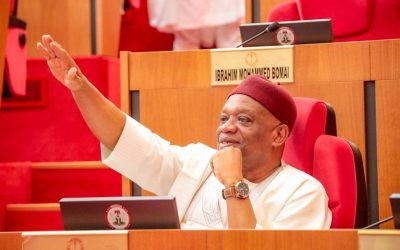













The controversy surrounding Senator Orji Uzor Kalu’s prediction that Governor Alex Otti may win the 2027 Abia governorship election should not be allowed to degenerate into another needless crisis within the All Progressives Congress (APC). Rather, the statement should serve as a wake-up call, a moment of introspection and a strategic warning to the APC in Abia.
Political parties are built on ideas, structures, strategies and the ability to read the political environment. A senior political leader who has considerable knowledge of Abia’s political terrain should not be condemned simply because his assessment of the prevailing circumstances is uncomfortable to some party members.
There is an important distinction between prediction and endorsement. To predict that a particular candidate is likely to win an election is not necessarily to declare support for that candidate. Indeed, reports of Senator Kalu’s interview indicate that while he expressed confidence that President Bola Ahmed Tinubu would win Abia in the 2027 presidential election, he also predicted that Governor Otti could retain the governorship. When specifically asked whether there was an alliance between the APC and Otti, Kalu reportedly answered in the negative.
The appropriate response from the APC should therefore not be persecution, intimidation or threats of disciplinary action. The appropriate response should be introspection.
If a prominent APC leader, with a long history in Abia politics, believes that the incumbent governor currently has an advantage in the governorship contest, the critical question for the party should be: What is responsible for that advantage, and what must APC do differently to overcome it?
That is the real message embedded in Kalu’s statement.
Rather than shooting the messenger, the APC should examine its own house. Are all stakeholders sufficiently united? Are aggrieved members being reconciled? Is the party adequately connected to the grassroots? Does its leadership enjoy the confidence of ordinary party members? Are its structures functional across the wards and local government areas? Is the party sufficiently communicating its achievements under the Tinubu administration to Abians? And, perhaps most importantly, does the APC have a candidate capable of inspiring broad-based support across the state?
These are the questions that should occupy the attention of APC stakeholders.
It is also important to remember that Senator Kalu is not a political newcomer making an armchair assessment of Abia. He is a former governor of the state and currently represents Abia North in the Senate on the APC platform. His political experience and familiarity with the state’s political dynamics make his assessment worthy of serious consideration, whether one agrees with it or not.
Indeed, the political objective should be to prove the prediction wrong at the ballot box, not to punish the person who made it.
If APC believes that it can defeat Governor Otti in 2027, then the answer is straightforward: strengthen the party, reconcile its factions, accommodate divergent opinions, mobilise the grassroots, present a credible candidate and develop a winning campaign strategy.
It is noteworthy that earlier reports had even placed Senator Kalu among political leaders working to build an APC platform aimed at defeating Governor Otti in 2027. This context makes it even more difficult to reasonably interpret one political prediction as evidence of a deliberate decision to work against the APC.
A healthy political party must be capable of accommodating internal debate. Loyalty to a political party should not mean intellectual conformity. Party members can disagree about electoral prospects, strategies and personalities while remaining committed to the overall objectives of the party.
For the APC in Abia, therefore, Senator Kalu’s statement should be converted from a source of controversy into an opportunity. It should compel the party to conduct an honest assessment of its strengths and weaknesses ahead of 2027.
The APC does not need a party where everyone merely says what the leadership wants to hear. It needs a party where stakeholders can speak frankly, identify weaknesses and collectively devise solutions.
The ultimate response to Kalu’s prediction should be better organisation, stronger unity, wider consultation and more effective mobilisation.
If APC disagrees with his prediction, it has the democratic means to demonstrate that disagreement. It should go to the people of Abia with a compelling message and earn their votes.
That is how political parties win elections.
Senator Orji Uzor Kalu’s prediction should therefore be understood not as an invitation to fight within the APC, but as an invitation to wake up, look inward and get to work.
Ikenna Dozie