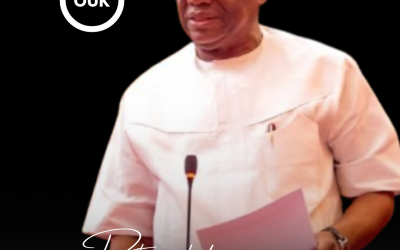
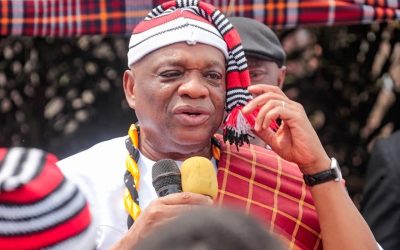
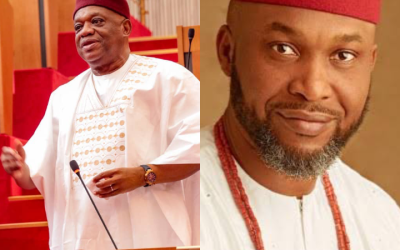



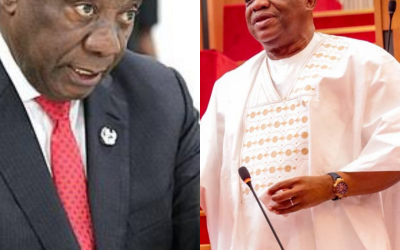
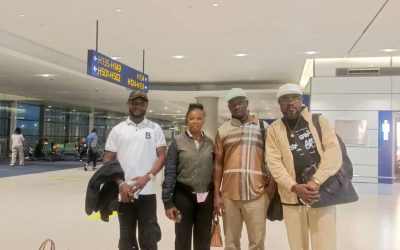


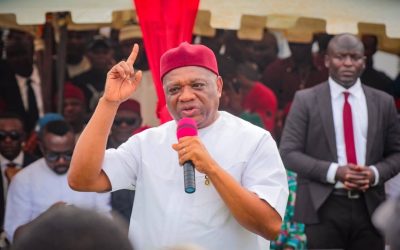

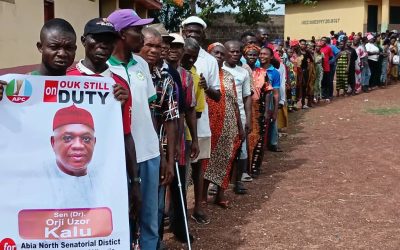

















In a compelling call to action, renowned global cybersecurity and artificial intelligence expert, Charles Awuzie, has publicly appealed to Senator Orji Uzor Kalu to help modernise Nigeria’s private security sector, a recognition of the senator’s proven track record in managing insecurity during his tenure as Abia State Governor.
Awuzie, who is the Chief Executive Officer of Gemsbok Group, a South African-based information technology company, and co-founder of Transhuman Coin, made the appeal in a Facebook post where he recounted the success story of the Bakassi Boys vigilante group under Governor Kalu’s administration in Abia State during the early 2000s. The cybersecurity specialist, who holds expertise in ethical hacking, software engineering, and artificial intelligence, described how the Bakassi Boys of OUK transformed the security landscape of the Southeast region using Orji Kalu’s model, particularly in combating the notorious criminal, Derico Nwa Mama and other dangerous criminal networks.
In his Facebook post, Awuzie recounted a vivid picture of the insecurity that plagued the Southeast in the early 2000s. In his words, which we were all witnesses to, the different criminal gangs robbed banks in broad daylight, left dead bodies behind with tummies ripped open, and set public transportation buses ablaze with passengers inside. Awuzie in the post also alleged that the police proved incapable of arresting Derico and his boys, with some claiming he used supernatural powers, but in reality, he was simply extremely strategic and a genius in criminal operations.
The cybersecurity expert who was an Aba boy during this period explained how the Bakassi Boys emerged as a solution. The dreaded Bakassi Boys were traders from Aba who grew tired of the insecurity that forced them to shut down their shops out of fear of attacks. These traders decided to resist the criminals, giving birth to the Bakassi Boys. They were fearless, going after the most feared bandits and publicly executing them, which led to a dramatic 95% drop in crime in Aba.
According to historical records, the Bakassi Boys emerged with the support of then Governor Orji Uzor Kalu, who saw the effectiveness of the group in combating crimes in Aba and its environs and gave them a very conducive operating environment and every support. The vigilante group’s success in Abia State led to its expansion to neighbouring Anambra State where it was legally recognised through a special law adopted in August, 2000.
He recounted the dramatic capture of Derico Nwa Mama, explaining how the Bakassi Boys used intelligence gathering networks to learn the criminal’s movement patterns. They discovered that Derico used public transport to shield himself and laid an ambush for him. On the day of his capture, he was arrested whilst entering Anambra disguised as a passenger in public transport. The news filtered into the city, and the entire Southeast rejoiced as if it were Christmas.
Building on this historical context, Awuzie proposed a modernised private security approach to combating Nigeria’s security challenges. He envisioned well-regulated, well-equipped, and well-trained versions of vigilante groups that would rely on advanced intelligence and surveillance systems rather than traditional methods. He suggested that these modern private security companies could be funded by major corporations such as Dangote Group, UBA, Globacom, or Zenith Bank, operating as Dangote Security, UBA Security, Globacom Security Company, or Zenith Security Solutions.
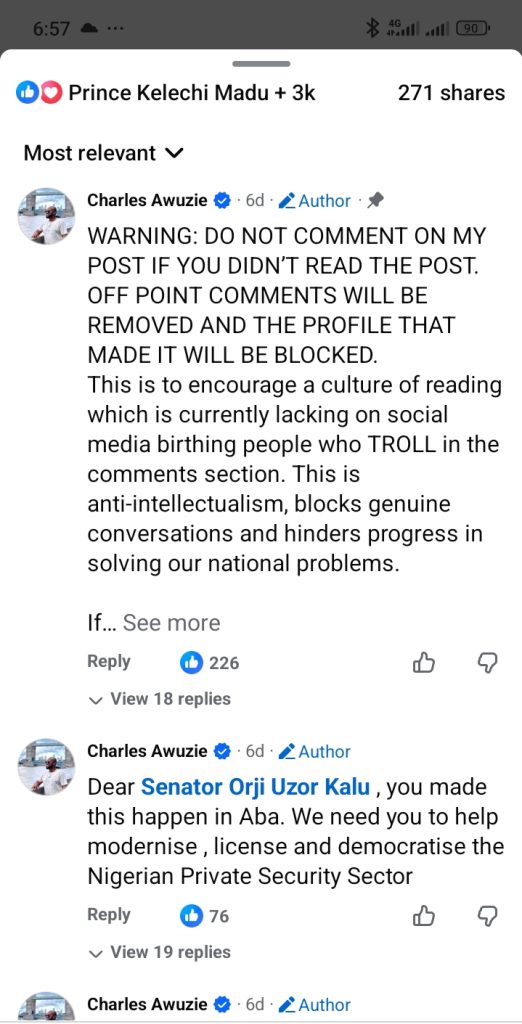
In a direct comment under his post, Awuzie specifically addressed Senator Orji Uzor Kalu, stating: “Dear Senator Orji Uzor Kalu, you made this happen in Aba. We need you to help modernise, license, and democratise the Nigerian Private Security Sector.”
The appeal to Senator Kalu is rooted in the senator’s demonstrated capacity to establish effective security architecture during his governorship. Historical records show that under Kalu’s administration, the Bakassi Boys enjoyed significant support and achieved remarkable success in reducing crime rates in Abia State, particularly in the commercial hub of Aba.
By calling on Senator Kalu to lend his experience and influence to this initiative, Awuzie is recognising the experience and strategic structuring ability of Kalu, a ranking senator. Not by theory but having the practical capacity, and by virtue of his strategic position in the National Assembly
During his governorship from 1999 to 2007, he was known for his hands-on approach to security matters. As a senator, he has sponsored various bills and motions related to national security and regional development.
The proposal also raises important questions about regulation, oversight, and the relationship between private security companies and government security agencies. Awuzie’s call for Senator Kalu to help modernise, license, and democratise the Nigerian private security sector suggests recognition of these concerns. Proper licensing frameworks, clear operational guidelines, robust oversight mechanisms, and coordination protocols with government security agencies would be essential to prevent human rights violations.
Charles Awuzie is a highly respected figure in the African technology and cybersecurity landscape. He currently resides in South Africa, where he leads Gemsbok Group. He holds a biochemistry degree from Abia State University and has acquired multiple diplomas and certificates in business leadership, cybersecurity, information technology, and Linux administration. Awuzie is also a certified ethical hacker with expertise in CompTIA Security Plus and has completed Harvard University’s CS50 certification under renowned computer scientist David J Malan. He was the leader of the Nigerian Internet Initiative in the Eastern Region from 2007 to 2009, overseeing six states and introducing indigenes to internet technology opportunities. His work spans software engineering, cybersecurity, cryptocurrency innovation, and entrepreneurship.